Best Programming Language for Test Automation: 4 Real Picks
You have three browser tabs open. One tutorial says Java, another swears by Python, and the job post you actually want mentions TypeScript. Choosing the best programming language for test automation shouldn’t feel like a bet on your whole career, yet right now it does.
Here’s a calmer way to see it. Your exploratory testing, domain knowledge and edge-case instinct already do the hard part of this job.
The language is a tool, and the right one depends on the people who will review your code and the jobs you want. This guide compares Python, TypeScript, Java and C#, then gives you a 12 week plan so you can stop comparing and start writing.
Quick answer: which language should you learn?
The best programming language for test automation is the one your developers already review and your target employers already hire for. With no constraint, I’d pick TypeScript with Playwright for web apps, Python with pytest for APIs and data-heavy teams, Java with Selenium for large enterprises, and C# for Microsoft shops.
Table of Contents
How to choose the best programming language for test automation
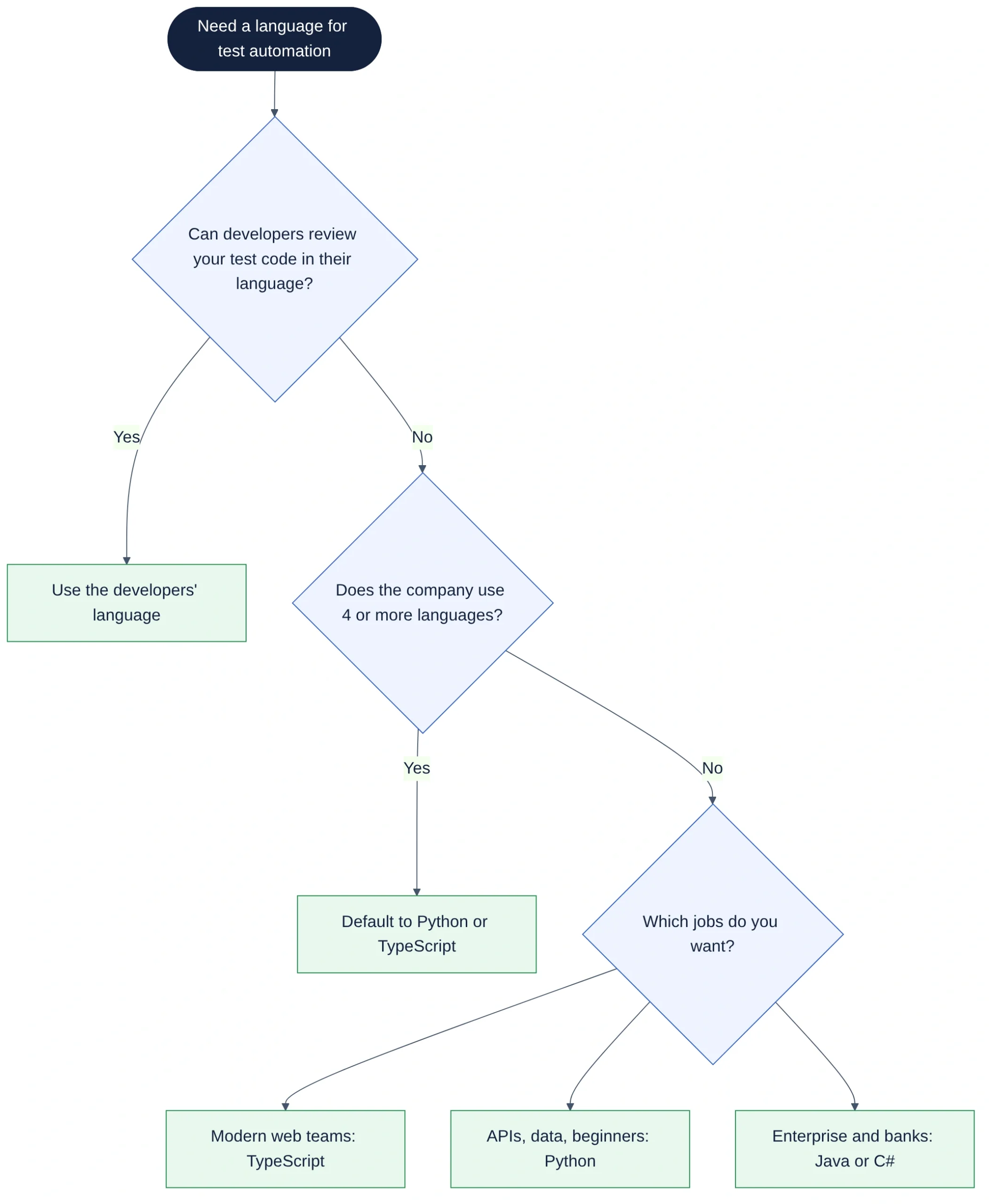
Start with people, not popularity charts. If you already work somewhere, find out which language the developers write the product in. When testers and developers share a language, developers can review your test code, help debug a flaky test and share libraries, build scripts and IDE licenses.
Then read ten job posts for the role you want, in the region you want. Count the languages. That tally tells you more than any survey, because it reflects what a hiring manager will ask you to write in a live coding round.
When matching the developers is the wrong call
Matching has limits. If the developers write in a language with thin browser automation support, COBOL for example, copying them gets you nowhere. And if the company runs four or five languages across microservices, pick the neutral option, usually Python or TypeScript, so nobody owns the suite by accident.
One rule I’d never bend: don’t import application modules into your test code. If the test reuses the same function that contains the bug, the test inherits the bug and stays green. Unit tests are the exception, since they belong in the product’s language anyway.
Learn one language before any tool
Variables, loops, conditions, functions, lists and basic object-oriented ideas carry over between Python, TypeScript, Java and C#. In my view, a second language later is mostly a syntax exercise, not a restart.
Most beginners open a Playwright or Selenium tutorial on day one and copy code they can’t read. That’s the wrong order. The first time a locator fails, or an interviewer asks for a reverse-a-string function on a shared screen, they have nothing to fall back on.
I’ve watched this happen with a colleague who started with tools. He could record and replay scripts, but a small DOM change, a timing issue or a network call left him stuck. His scripts filled up with duplicated code and hardcoded values, and debugging felt like guessing in the dark.
Here’s how I’d coach him. He steps away from the tool for a few weeks and spends 30 minutes a day on variables, loops, conditions and objects. His micro-tasks have nothing to do with automation, like reading a local text file, filtering the lines and printing the result. No selectors, no tool.
Next I’d refactor one long script with him, moving repeated code into helper functions and Page Objects. Then I’d show him the API call behind a click in DevTools, break one of his tests on purpose, and have him find the cause from the error log. Last comes Git and a pull request, so his tests run in CI.
Write five to ten small programs first, with no browser involved. Finding the most frequent letter in a string is the kind of task coding rounds like to ask.
Pay is real, but the language is not the lever
The US Bureau of Labor Statistics lists median pay for software quality assurance analysts and testers at $104,300 in May 2025. That figure covers all testers, not only automation specialists. PayScale shows average SDET pay near £57,133 in the UK and €41,000 in Ireland.
Salary aggregators disagree wildly, so check three sources for your city before you negotiate. I’d also argue that pay follows automation skill and seniority far more than it follows which of these four languages you picked.
Python, TypeScript, Java and C# compared side by side
Playwright behaves the same in every language it supports. What changes is the test runner ecosystem around it, and Playwright’s language guide says to pick based on your experience, your familiarity with that ecosystem and your project constraints. The table below is built around that idea, so read it as a map of fit rather than a ranking of the best programming language for test automation.
| Language | Learning curve | Typical test stack | Best fit | Main snag |
|---|---|---|---|---|
| Python | Gentlest start | pytest with pytest-playwright, or Selenium | API checks, data-heavy teams, first-time coders | Virtual environments confuse newcomers |
| TypeScript | Moderate | Playwright Test, Cypress, WebdriverIO | Modern web apps and SaaS products | async/await: a missing await breaks tests quietly |
| Java | Steepest start | Selenium, Maven, JUnit or TestNG, REST Assured | Large enterprises, consultancies, older suites | Build setup and boilerplate before the first test |
| C# (.NET) | Moderate | Selenium or Playwright with NUnit, MSTest or xUnit | Microsoft and Azure shops | Mostly useful when developers already use .NET |
Python: the gentlest start
Python reads close to plain English, needs no compiler setup, and lets you write a working browser test in a handful of lines. That’s why I’d point an absolute beginner here first when there’s no job target yet.
A pytest automation framework gives you fixtures, parameterized tests and readable failure output. Playwright’s own docs call the pytest plugin the recommended way to run end-to-end tests in Python, so you’re not off the beaten path.
Python also covers API checks and load testing without switching languages. That helps if your team does more backend work than UI work.
TypeScript: the web-first choice
If your target is a modern web product, Playwright with TypeScript is where I’d look first. Playwright Test is its own runner for Node.js, with parallel runs, an HTML report and automatic tracing built in, so you don’t assemble a stack from five libraries.
People ask whether to learn JavaScript for QA automation or go straight to TypeScript. I’d go straight to TypeScript. Playwright’s docs say you need no prior TypeScript experience and that it works out of the box, and the type checks catch silly mistakes before your pipeline does.
The hurdle is asynchronous code. Most Playwright calls return a Promise, so a forgotten await is the classic beginner bug. Playwright’s best-practices guide recommends the no-floating-promises lint rule to catch exactly that.
Python vs TypeScript Playwright is mostly a question of people, not features: the browser engine and core API behave the same either way. Pick Python for the gentlest syntax. Pick TypeScript when the postings you want say TypeScript or your developers already write it.
Cypress end-to-end testing is a fair alternative if you only ever want JavaScript or TypeScript, but it doesn’t cover other languages, so it’s a narrower bet.
Roundups of 2026 survey data put Playwright near 45 percent adoption among QA professionals, with Selenium around 22 percent. That comes from a community survey, not a census, so read it as direction. TestGuild’s own recap of its 2026 survey says Playwright is the tool testers most want training on.
Java: the enterprise workhorse
Java remains the default in many large enterprises and consultancies, and Selenium with Java is the stack those teams tend to inherit. If a posting says Selenium, Maven and TestNG, that’s your signal.
One February 2026 snapshot from TestDino counted about 8,800 US Indeed results for Selenium automation testing jobs and about 10,200 for QA automation Playwright. Search counts are noisy, so I read that as “both stacks are hiring”, not as a scoreboard.
On Python vs Java for test automation, the honest trade-off is ceremony. Java’s strict typing and build tooling catch problems early, but you write a pom.xml and a class wrapper before your first assertion runs. Python gets you to a green test faster. Java gets you into more enterprise doors.
Many online tutorials default to Java with Selenium because that stack dominated outsourced service projects for years. Newer product teams tend to start with TypeScript or Python instead. Check which world your target employers live in.
C# and .NET test automation: the Microsoft shop pick
C# .NET test automation makes sense when your developers live in Visual Studio and Azure. You get NUnit, MSTest or xUnit, and Playwright’s .NET package ships base classes for those runners, so the glue code stays small.
Outside Microsoft shops I wouldn’t pick it first, mainly because nobody on a non-.NET team could review your code.
The same test in TypeScript, Python and Java
Talk is cheap, so here’s one tiny test written three ways. Each opens Playwright’s supported languages page and checks that the top heading is visible. Same intent, very different amounts of ceremony.
Save this TypeScript version as tests/languages.spec.ts after running npm init playwright@latest:
import { test, expect } from '@playwright/test';

test('languages page shows its heading', async ({ page }) => {
  await page.goto('https://playwright.dev/docs/languages');
  await expect(
    page.getByRole('heading', { name: 'Supported languages', level: 1 })
  ).toBeVisible();
});
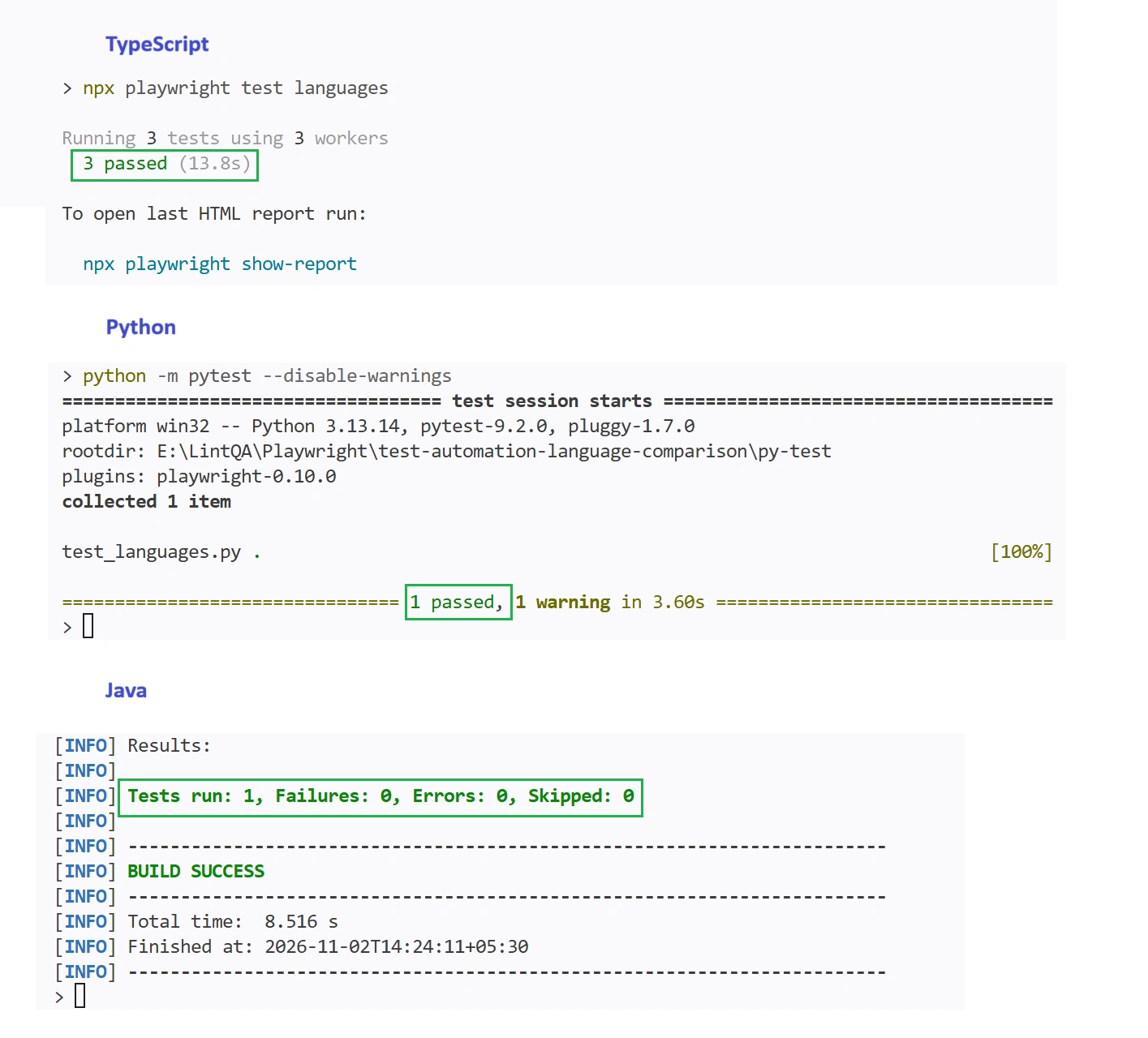
The locator finds the heading by role and visible name, the way a user would, and toBeVisible() keeps retrying until the heading appears or the timeout ends. Run npx playwright test. The default config runs three browser projects, so expect a line ending in 3 passed. On my run it printed Running 3 tests using 3 workers and 3 passed, with a time that varies by a second or two between runs.
Here is the Python version with pytest-playwright. Install it with pip install pytest-playwright, then playwright install, and save the file as test_languages.py:
from playwright.sync_api import Page, expect

def test_languages_page_heading(page: Page):
    page.goto("https://playwright.dev/docs/languages")
    expect(
        page.get_by_role("heading", name="Supported languages", level=1)
    ).to_be_visible()
The page argument is a fixture the plugin provides, so there is no browser setup code. Run pytest. By default it uses Chromium in headless mode, so expect 1 passed. On Windows, if playwright or pytest isn’t recognized, run them as python -m playwright install and python -m pytest. My run also showed a pytest deprecation warning about a session-scoped fixture. It comes from the plugin, not your test, and the test still passed.
And the Java version with JUnit 6. Add the com.microsoft.playwright:playwright:1.64.0 dependency and junit-jupiter (I used 6.1.3) to your pom.xml, plus the Maven Surefire plugin (I used 3.5.4) so mvn test can run JUnit 6 tests, then save this as LanguagesPageTest.java:
package org.example;

import com.microsoft.playwright.*;
import com.microsoft.playwright.options.AriaRole;
import org.junit.jupiter.api.Test;

import static com.microsoft.playwright.assertions.PlaywrightAssertions.assertThat;

class LanguagesPageTest {

  @Test
  void showsPageHeading() {
    try (Playwright playwright = Playwright.create()) {
      Browser browser = playwright.chromium().launch();
      Page page = browser.newPage();
      page.navigate("https://playwright.dev/docs/languages");
      assertThat(
        page.getByRole(AriaRole.HEADING,
          new Page.GetByRoleOptions().setName("Supported languages").setLevel(1))
      ).isVisible();
    }
  }
}
Run mvn test. The Java docs note that the first run downloads Playwright and installs browser binaries, and Maven’s summary should end with Tests run: 1, Failures: 0, Errors: 0, Skipped: 0 followed by BUILD SUCCESS. My first run took about 19 seconds in total, including the downloads, and later runs took under 10 seconds.
Count the lines. The Java version is more than double the length of the other two, and that’s before the build file. None of it is hard, but it’s friction a beginner feels in week one. The three files and the pom.xml live in one repo: test-automation-language-comparison on GitHub.
Which languages and tools to skip in 2026
When you’re choosing the best programming language for test automation in 2026, I’d skip Ruby, PHP and Perl as a first language unless your team already uses one. Playwright officially supports JavaScript and TypeScript, Python, Java and .NET, so those three aren’t on its list. Selenium does have Ruby bindings, which is why a Rails shop has a real reason to stay.
VBScript is mostly a legacy story, tied to older Windows-only tools like UFT. I wouldn’t start there either.
Codeless tools: learn code first
Katalon, Tosca and mabl are fine products. But I’d learn an open source coded framework first, because once you can read code, a low-code tool is an easy second step. The reverse path is much harder.
BDD is a team habit, not a language
Cucumber and Gherkin are about collaboration: product, developers and testers agreeing on behavior in plain sentences. They don’t replace a programming language. Many teams skip the extra layer and write clean Playwright Test or pytest scripts, so learn a standard test runner first.
How AI assistants change the choice, and what they don’t
AI coding assistants write test code in any of these languages, so they lower the cost of typing. They don’t lower the cost of reading. If you can’t tell a useful assertion from a decorative one, you can’t tell when the assistant is wrong.
Picture a generated test that clicks Checkout and then asserts only that the page didn’t crash. It passes forever, even when the order total is wrong. You need basic coding fluency to spot that in review, and to debug the failure that lands in your pipeline at 6 p.m.
Playwright has leaned into this. Version 1.56 introduced test agents named planner, generator and healer. Since 1.62, the Playwright MCP server and a command line tool are bundled and run through npx playwright mcp.
Playwright MCP lets an assistant drive a real browser using the page’s accessibility tree instead of screenshots. That’s the honest picture of AI test automation in 2026: faster drafts, same need for judgment.
In my view, TypeScript’s type checks and Python’s readability both help here, because you review AI output faster in a language you can read. The assistant is a quick junior. You’re the reviewer.
From manual QA to SDET: a 12 week roadmap
Many testers hesitate to call themselves manual testers, and I get it. Exploratory testing, domain checks and edge-case analysis are real engineering skills. A transition from manual testing to automation just adds code to a toolkit you already have.
Here’s the order I’d follow. It’s an estimate that assumes steady weekly study, not a promise, and it works as a manual QA to SDET roadmap whether you pick Python, TypeScript or Java. For the wider path through APIs, mobile, performance and AI, my software testing roadmap covers six stages, and this plan zooms in on the automation stage.
| Weeks | Focus | What you can show |
|---|---|---|
| 1 to 3 | Programming basics: variables, loops, lists, strings, functions, object-oriented basics | 5 to 10 solved algorithm tasks in a public repo |
| 4 | Web DOM and locators: HTML structure, browser DevTools, CSS selectors, XPath, data-testid attributes | A list of resilient locators for one real page |
| 5 | API testing: HTTP methods, status codes, JSON checks in Postman, then the same checks in code | A small API test suite |
| 6 to 8 | UI automation and waits: 5 to 10 end-to-end flows with clean assertions | Flows that pass on repeat runs |
| 9 to 10 | Framework basics: Page Object Model (POM), external test data, config files, reporting | A structured project |
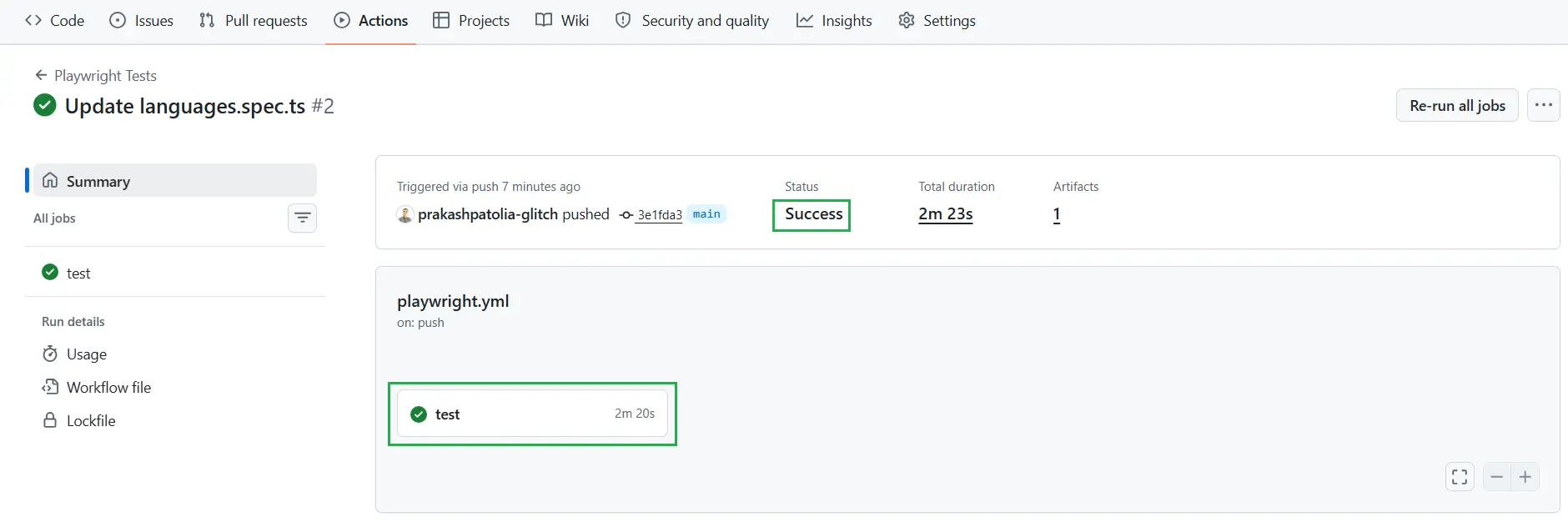
| 11 to 12 | Git and CI/CD pipeline integration with GitHub Actions or Jenkins | A public repo with a green pipeline |
Weeks 1 to 5: code, locators and APIs before flaky UIs
Do the API week before you chase browser tests. API checks run faster and flake far less, and they teach you requests, responses and JSON, which you’ll reuse for test setup later.
When you reach locators, learn why role-based ones win. Playwright’s best-practices guide shows a CSS-class button locator as the fragile option and a role plus name locator as the resilient one. A designer renames a class on Friday, and the green suite turns red by Monday.
If you inherit a suite full of XPath, the free XPath to Playwright locator converter turns fragile XPath and CSS selectors into role, test id and label locators, with TypeScript and Python output.
Weeks 6 to 8: waits, assertions and stability
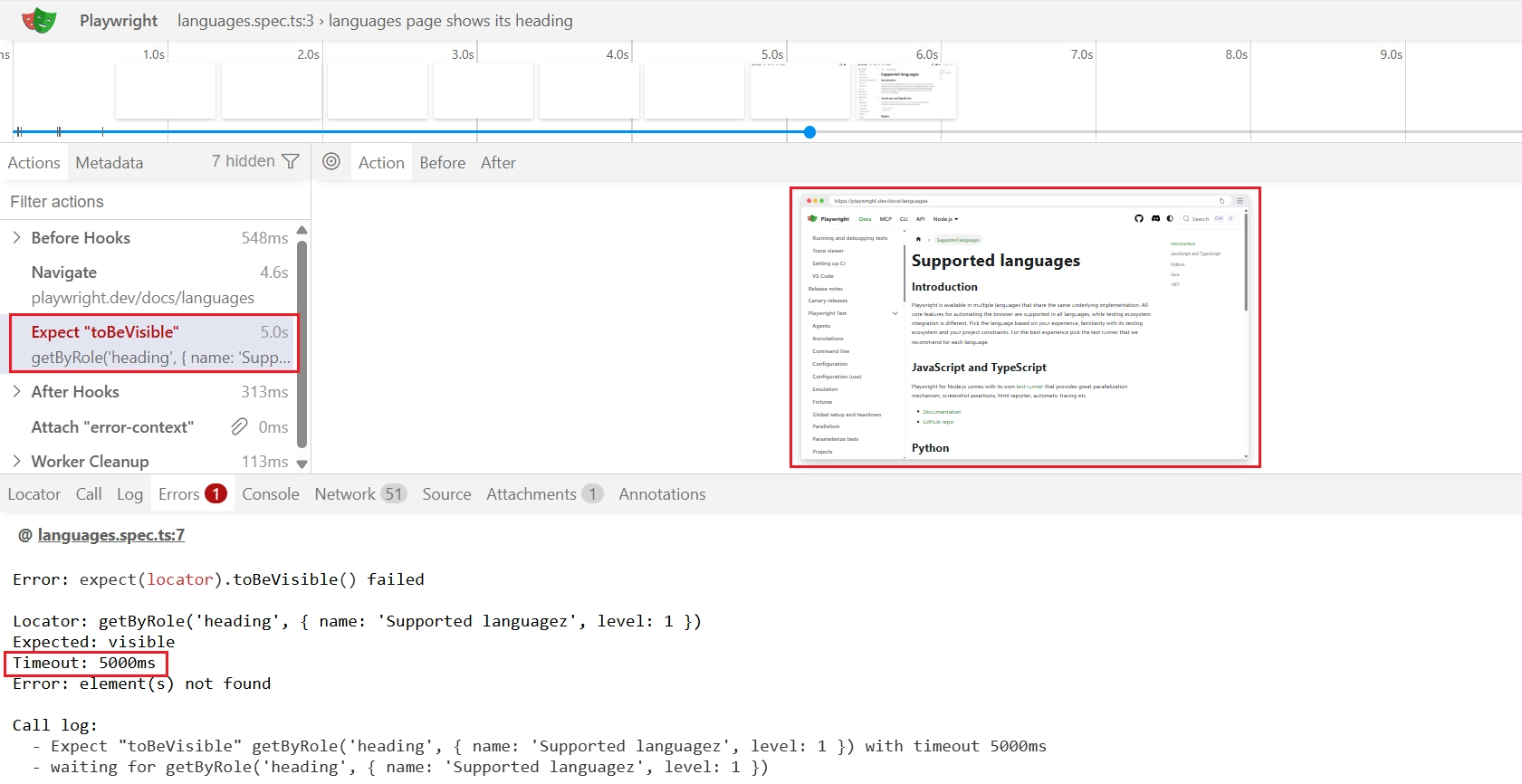
Before a click, Playwright runs actionability checks: the locator must resolve to exactly one element that is visible, stable, receiving events and enabled. If the checks don’t pass in time, the action fails with a TimeoutError. That’s why a fixed sleep is the wrong fix.
Assertions matter just as much. Playwright’s guide warns that asserting on the result of isVisible() returns immediately without waiting, while await expect(...).toBeVisible() retries. That one difference explains a lot of flaky tests.
Everyone says automate as much as you can. I’d rather have twelve stable end-to-end tests than a hundred the team re-runs until they go green. Aim for five to ten trusted flows here.
Weeks 9 to 12: structure, Git and CI
The Page Object Model (POM) wraps each page’s locators and actions in one class, so a changed button means one edit, not forty. Keep test data in JSON or YAML, and keep secrets and real customer data out of the repo, especially under GDPR.
On CI, Playwright’s guide recommends Linux because it costs less, installing only the browsers you need, and recording traces on the first retry instead of on every test. The trace viewer then shows a timeline, DOM snapshots for each action and network requests for a failure you can’t reproduce locally.
Sharding splits a suite across machines, which helps when a regression run must fit inside a CI time limit. On one project, a 200-test Playwright suite that took 32 minutes on a single worker finished in 11 minutes after I split it across four CI shards.
Two small details are worth knowing. Since 1.62, headless runs isolate the clipboard from the operating system. And 1.64 adds a --shuffle option that randomizes test order, a quick way to find tests that secretly depend on each other.
Before you add more tests, decide which ones earn a place. My guide on what to automate first in regression testing ranks tests by risk and sorts them into four waves.
Finish by pushing everything to a public GitHub repo with a README and a green pipeline. Recruiters can open a repo in thirty seconds. They can’t open your memory of a course.
What to check before you commit to a language
Run three quick checks. First, ask one developer what the product is built in and whether they’d review your test code. Second, tally the languages in ten postings you’d genuinely apply to. Third, write one small program in your shortlisted language this weekend. If it feels hostile, switch before week three, not after week ten.
A careless version of this choice follows a trending video instead. Whichever language you pick, the same habits carry over when you move on to Playwright, Selenium, Appium or JMeter: stable locators, honest assertions and a pipeline that runs your tests on every commit.
When this advice does not apply
This guide assumes web and API testing. For native mobile work with Appium, or load testing with JMeter, your team’s existing language pulls harder than this comparison does.
If you’re a Ruby shop, Selenium is the realistic route, since Playwright doesn’t list Ruby. And if you’re hired onto an existing suite, you learn its language. This comparison is for choosing, not inheriting.
Bottom line: pick for your team, then write code this week
The best programming language for test automation is a decision about people and postings, not syntax. Your developers’ stack and the jobs you want will point to one of four names, and a wrong pick in week one costs far less than three half-learned tools in week twelve.
Today, ask one developer what the product is built in, tally ten job postings, and write your first ten-line program in whichever language wins. Then run it, break it on purpose, and read the error.
Questions testers ask before they pick a language
What is the easiest programming language for manual testers to learn first?
There is no single best programming language for test automation, but for a first pick: Python, if you have no coding background and no target employer yet, because its syntax is the gentlest and pytest is a clean first framework. Choose TypeScript instead if the postings you want mention Playwright with TypeScript, or if your developers already write it. I’d decide in a weekend and then stop re-deciding.
Can I learn automation without a coding background?
Yes. Automation testing for beginners without a coding background works when code comes first and tools second. Start with small programs, then locators, then a framework, following the roadmap above. Expect the first three weeks to feel slow.
How to switch from manual to automation QA without leaving your job?
Start by automating one boring regression check from your own team’s checklist, in the language your developers use, and ask for an hour a week to pair with a developer. To learn locators quickly, run Playwright’s codegen. It records your clicks and proposes role, text or test id locators, which you can then rewrite by hand.
Is Selenium still worth learning in 2026?
Yes, if the jobs you want ask for it. Selenium supports more languages than Playwright, including Ruby, and large enterprise suites aren’t disappearing overnight. With no such target, I’d start with Playwright and add Selenium later.
Do I need Cucumber or BDD to get an automation job?
No. BDD is a collaboration habit, and plenty of teams run plain Playwright Test or pytest instead. Learn it only if a posting you want asks for it.